

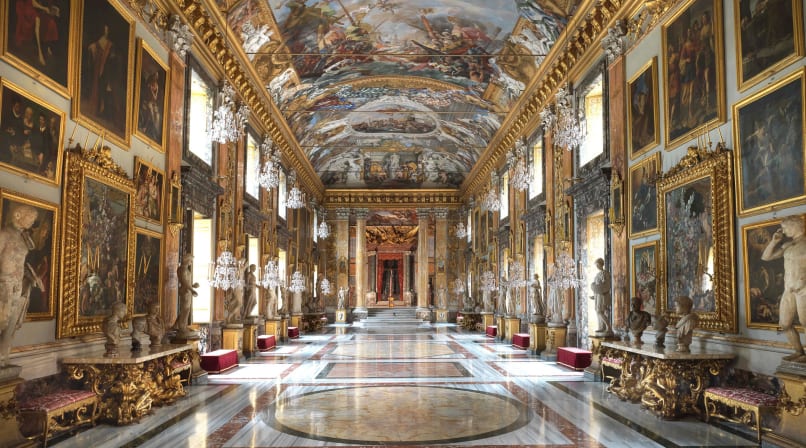


A true jewel of the Roman Baroque, the Colonna Gallery was commissioned in the mid-16th century by Cardinal Girolamo I Colonna and his nephew, Lorenzo Onofrio Colonna. It was inaugurated in 1700 by Lorenzo Onofrio's son, Filippo II.
The original design was made by the architect Antonio del Grande; it was completed in the last decades of the 1600's by Gian Lorenzo Bernini, Paolo Schor and Carlo Fontana.
From the beginning, the Gallery was conceived as a grand representation hall to celebrate the victory of the Christian fleet over the Turks at the Battle of Lepanto in 1571.
Marcantonio II Colonna was the true victor of the Battle of Lepanto in 1571: the entire decoration of the Gallery was dedicated to him. This important historical event is depicted in the frescoes of the Great Hall, which owe their splendor to the mastery of painters such as Coli and Gherardi. On the other hand, the frescoes in the Sala dei Passaggi, with the wonderful "Allegory of the Battle", date back to the 18th century. The Hall of Columns is therefore an authentic celebration of Marcantonio II and his apotheosis.
The whole gallery is designed to be seen as an artistic jewel in itself: the pictorial masterpieces are innumerable and the fact that the inspiration of Tintoretto, Guido Reni, Pietro da Cortona and many others was used. Antique marbles and frames with a vague and sensual baroque flavor complete the splendid collections of the family.
Finally, very interesting in the context of this apartment are the caskets in the Hall of Passages, truly magnificent and precious, an authentic treasure of wood and precious stones (a true triumph of ebony and ivory craftsmanship).
The other authentic wonder of the Colonna Gallery is undoubtedly the apartment of Princess Isabelle.
It is basically a wing of the palace, dating back to the 15th century and still influenced by the important residence of Pope Martin V, who lived here until 1431. The main attractions of this apartment are certainly the frescoes by Bernardino di Betto, a painter better known as Pinturicchio, who was able to make the Fountain Room a true masterpiece. Instead, it was Cardinal Borromeo who stayed in these rooms in the 1500s, the period of maximum prestige and splendor for the building: the greatest artists and painters of the time passed through and breathed the Baroque air of the rooms. Gaspard Dughet and Carlo Cesi were responsible for the rich and extensive decoration of the later period. Nordic painting also has its place in this apartment: the paintings of Brueghel the Elder and Van Wittel's Views were jealously and preciously guarded, and today all visitors benefit from them.
The name of the apartment comes from the fact that Princess Isabelle Colonna stayed here until 1984: her grandchildren wanted to dedicate this wing, so refined and with such an important past, to her memory.